

Clear Is Kind: How to Have the Hard Conversations You've Been Avoiding

Photo by Priscilla Du Preez 🇨🇦 on Unsplash
Hard conversations are hard. That's not a groundbreaking statement, but it's worth saying out loud, because so much of what keeps us stuck is just how uncomfortable they feel. So today I want to focus on something practical: a few tools that make it a little easier to actually say the thing.
We all have someone we're avoiding a conversation with. A direct report whose work isn't where it needs to be. A partner whose habit is grating on you. A friend who keeps canceling. A parent, a sibling, a co-founder. The relationship is different every time, but the avoidance looks remarkably the same.
So let's talk about why we do it, what it actually costs us, and a framework I teach my clients that makes it easier to finally say the thing.
Why we avoid the conversation
Here's the honest answer: we avoid hard conversations to protect ourselves, not the other person.
We tell ourselves we're being kind by staying quiet. Really, we're managing our own discomfort. We don't want the awkward silence, the defensiveness, the risk that they'll be hurt or angry or that the relationship will feel different afterward. So we wait. We hint. We vent to someone else instead. We hope it resolves on its own.
It rarely does. The bigger it gets, the scarier it gets, and the harder it is to even bring up. What started as a small, easy conversation turns into a resentment that's been building for months.
The real cost of staying quiet
Avoidance feels like kindness in the moment. It isn't.
They can't fix what they don't know is broken. If you never tell your direct report their work is missing the mark, or your partner that their comment landed wrong, you're not sparing them. You're just deciding for them that they don't get the chance to do better.
And it rarely stays contained. Unspoken frustration leaks out sideways, in a short tone, a sigh, a project you quietly take off their plate instead of addressing. The other person usually feels that something is off long before you say anything. What they can't do is name it, or fix it, because you haven't given them the actual information.
One of our core jobs in any relationship, whether we're leading a team or showing up for the people we love, is to help the people around us grow. Withholding honest feedback isn't neutral. It's a failure to do that job.
The framework: Radical Candor
This is the model I teach my clients for actually having the conversation. It comes from Kim Scott's book Radical Candor, and it plots two things against each other: how much you show that you personally care, and how directly you challenge.
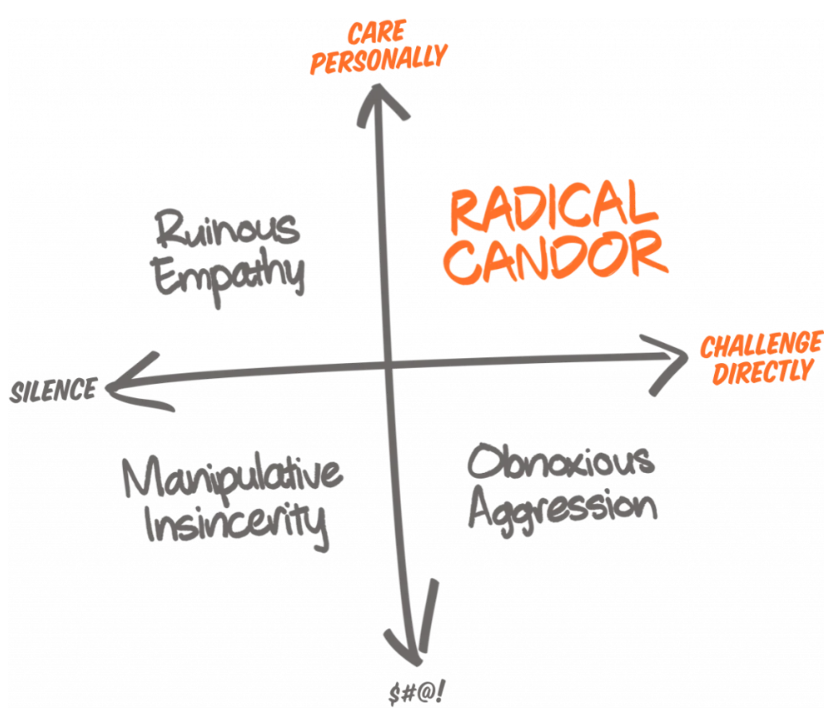
All too often, we default to Ruinous Empathy. We care, so we stay quiet, and we tell ourselves that's kindness. It isn't. The goal is the top right: caring enough about the person to tell them the truth, and caring enough about the truth to say it kindly.
"Clear is kind. Unclear is unkind."
I come back to this Brené Brown line all the time: "Clear is kind. Unclear is unkind."
It reframes the whole thing. We think softening the message, or not sending it at all, is the kind move. Brown's point is the opposite: vague, hedged, or withheld feedback is actually the unkind choice, because it leaves the other person guessing, or worse, never gives them the information at all.
Clear doesn't mean harsh. It means the other person walks away knowing exactly what you meant, with no decoding required. That's what Radical Candor is really asking for: care personally enough to be kind, challenge directly enough to be clear.
How to actually have the conversation
Knowing the framework and using it in the moment are two different things. A few things that make it easier:
Start small, on purpose. You don't have to open with the biggest, scariest version of the conversation. Pick the smallest true thing you can say, and start there. Momentum builds from there.
Name the behavior, not the person. "You're careless" invites defensiveness. "I noticed the last two reports had errors in the totals" is something they can actually respond to.
Lead with care out loud. Say the quiet part: "I'm telling you this because I think you're capable of more" or "I'm bringing this up because our relationship matters to me." Care Personally doesn't need to be assumed. State it.
Ask before you assume. "Help me understand what's going on" opens a conversation. "You clearly don't care about this" closes one. You may be missing context.
Get to the point. Don't bury the real message in five minutes of preamble. A long windup reads as anxiety and makes the other person brace for something worse than what's coming.
Expect it to feel uncomfortable, and do it anyway. The discomfort is not a sign you're doing it wrong. It's a sign you're doing something that matters.
Where this shows up for you
I'll keep teaching this through the lens of leadership, because that's where most of my clients live day to day. But notice how little of this is actually about titles or org charts. Care personally, challenge directly. Clear is kind. Start small. Those hold up with a direct report, a spouse, a best friend, a sibling, your own kid.
If there's a conversation you've been avoiding, you don't have to have the whole thing today. You just have to start small.
And if you want support figuring out what "starting small" looks like in your situation, that's exactly what I'm here for.